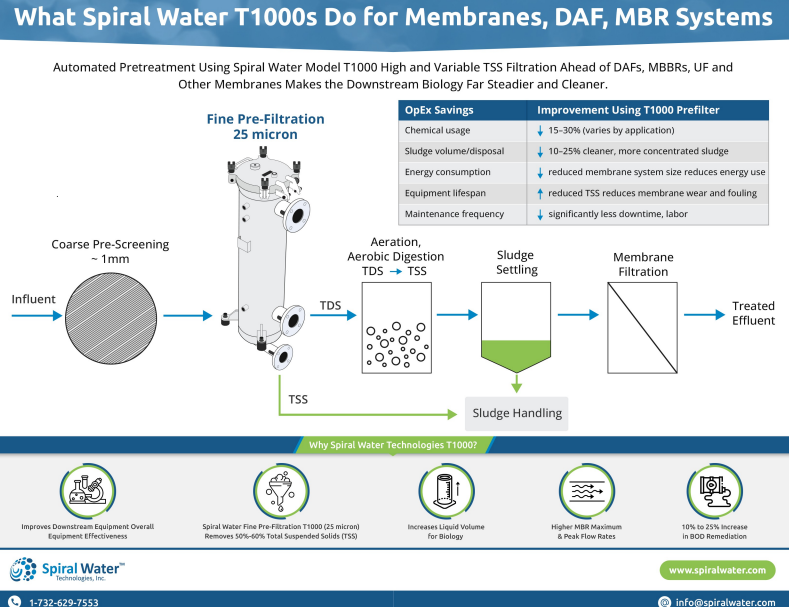
In any water treatment process, pretreatment determines how efficiently downstream systems perform. Removing large solids and stabilizing influent quality upstream can significantly reduce chemical use, maintenance needs, and overall operating costs.
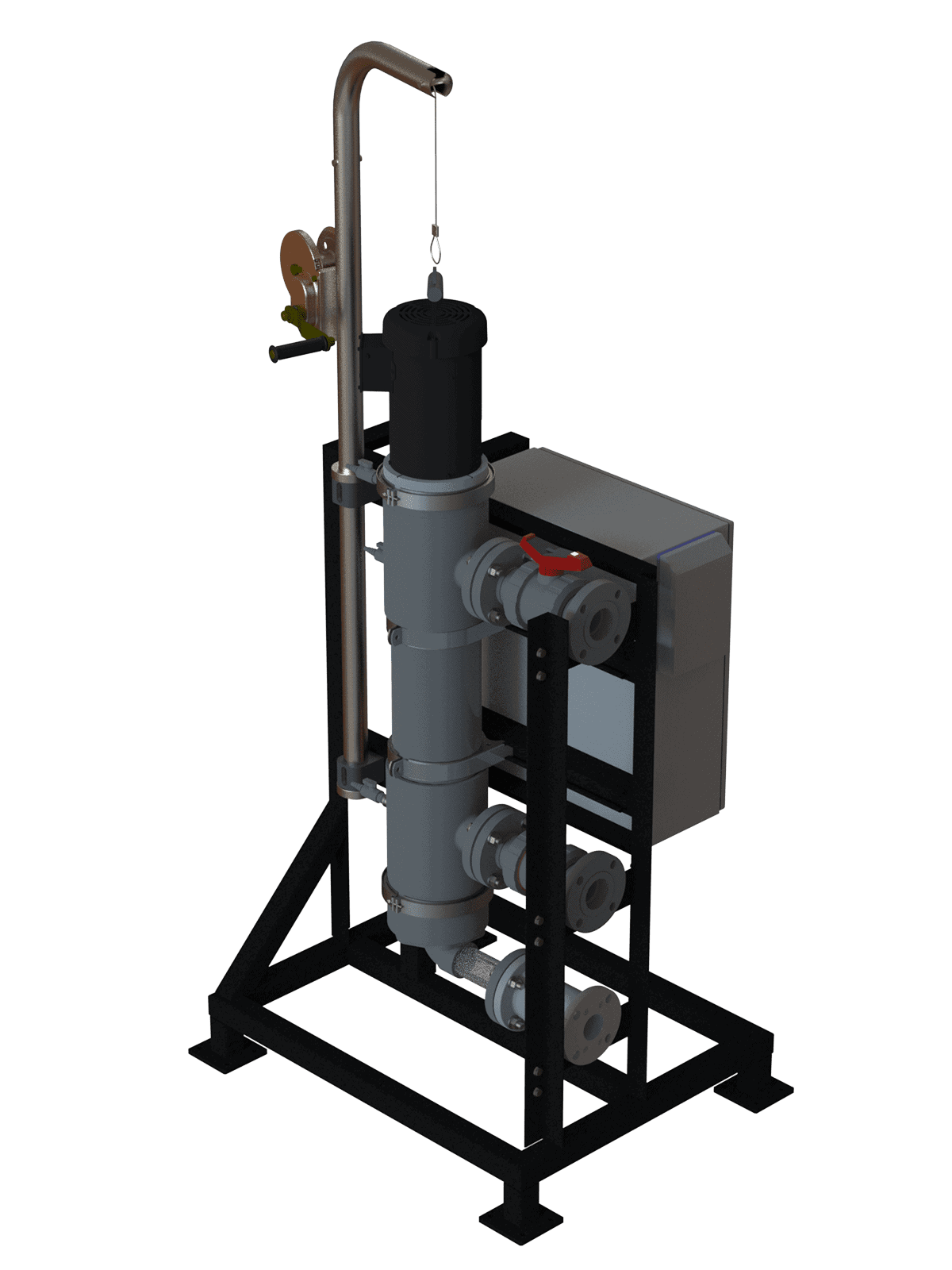
Using a Spiral Water T1000 with 25-50 micron screens as a prefilter to a dissolved air flotation (DAF) system is a proven way to enhance system performance and reduce operational expenses (OpEx). This integration helps facilities achieve more consistent, efficient wastewater pretreatment by removing large, settleable solids before they reach downstream processes.
The T1000 removes 70-90% of total suspended solids (TSS) greater than 50 microns before they reach the DAF system, helping to save time, reduce machine wear, and lower costs.
Installing a Spiral Water T1000 upstream of a DAF system can:
- Knock down TSS by 30–50% before DAF, particularly large and settleable solids
- Stabilize influent quality and reduce process variability
- Improve chemical performance by lowering coagulant demand
How Spiral Water T1000s Improve DAF Operations
For facilities that rely on DAF systems for wastewater treatment, adding a T1000 self-cleaning filter can deliver immediate performance and cost benefits. Below are the main ways it optimizes DAF operations and total cost of ownership.
Trim TSS Peaks and Narrow Variability
Without prefiltration, influent water often enters the DAF system with unpredictable surges in TSS, sometimes ranging from 1,000 to 3,000 mg/L. This can lead to membrane wear, excessive foaming, and reduced process stability.
The Spiral Water T1000 uses 25-50 μm screens to remove suspended solids in the 25–300 μm range, bringing the TSS feed down to a steadier 100-600 mg/L. This stabilization smooths food-to-microorganism (F/M) ratios, reduces biomass stress, and minimizes foaming or sloughing events. The result: consistent performance, higher uptime, and extended equipment life.
Reduces DAF Solids Loading
By removing larger suspended solids (>50 microns) before they reach the DAF system, the T1000 reduces the solids burden on the DAF. This allows the system to focus on finer particulates and FOG (fats, oils, and greases).
As a result, less particulate COD and TSS reach the bioreactor, meaning lower biosludge yield, less scum and ragging, and higher effluent quality overall.
Improves DAF Chemical Efficiency
DAF systems typically use coagulants and flocculants to bind particles and aid flotation. The T1000’s prefiltration process reduces the number of solids entering the DAF, which means less chemical dosing is required. With cleaner influent, facilities experience fewer CIPs and shorter soaks, less need for antifoam and polymer additives, and lower mixing energy.
Reduces DAF Maintenance and Downtime
Heavy solids loads often cause fouling and buildup in DAF tanks, pumps, and skimmers. The T1000’s self-cleaning filter intercepts these solids before they cause damage, protecting the DAF from abrasive materials.
This leads to fewer cleaning cycles, reduced maintenance costs, and less downtime. The self-cleaning mechanism also minimizes manual intervention for the filter itself, creating a low-maintenance, automated system that keeps operations efficient and predictable.
Enables Smaller or More Efficient DAF Systems
With prefiltered water, existing DAF systems can operate at higher throughput without compromising performance. A cleaner, more consistent influent allows the system to run closer to its design loading rate, sometimes even at higher hydraulic loads, without the risk of TSS-driven variability. For facilities planning capacity expansion, prefiltration can delay or reduce the need for additional reactor volume.
Decreases Overall Sludge Volume
Because the T1000 removes coarse solids at the start of treatment, those materials never mix with DAF-generated sludge. This improves sludge dewatering performance and helps reduce overall disposal costs.
Surcharge Savings
Water prefiltration pays for itself through OpEx savings. Facilities can expect:
- TSS surcharge savings: $300k–$400k per year for high-strength wastewater
- CIP and cleaning cost reductions: $30k–$80k annually
- Sludge handling and hauling reductions: $50k–$150k per year
- Typical payback period: less than 12–18 months when TSS fees or chronic fouling are present
What Are the OpEx Savings Breakdown With T1000 Self-Cleaning Filters?
| Area | Improvement from T1000 Prefilter |
|---|---|
| Chemical usage | ↓ 15–30% (varies by application) |
| DAF maintenance frequency | ↓ significantly (less downtime, labor) |
| Sludge volume/disposal | ↓ 10–25% (cleaner, more concentrated sludge) |
| Energy consumption | ↓ (less pumping resistance, smaller DAF) |
| Equipment lifespan | ↑ (reduced wear and fouling) |
Case Study: DAF Influent TSS Levels (Before Treatment)
| Industry / Application | Typical Influent TSS |
|---|---|
| Food & Beverage | 500 – 5,000+ mg/L |
| Meat / Poultry Processing | 2,000 – 8,000 mg/L |
| Dairy Processing | 1,000 – 6,000 mg/L |
| Oil & Gas (Produced Water) | 200 – 2,000 mg/L |
| Pulp & Paper | 1,000 – 10,000+ mg/L |
| Municipal (Pre-DAF, optional) | 100 – 500 mg/L |
| Textiles / Industrial Waste | 500 – 3,000 mg/L |
Note: These values can spike much higher during cleaning or batch discharges. Some food facilities see spikes >10,000 mg/L.
DAF CAPEX & OPEX Estimate (200 GPM)
| Parameter | High TSS (3000 mg/L) | Low TSS (1000 mg/L) w/ T1000 Auto Prefilter |
|---|---|---|
| CAPEX Estimate | $250,000 – $400,000 | $250,000 – $400,000 |
| TSS Load (lb/day) | 7,205.8 | 2,401.9 |
| Chemical Cost/day | $216.00 | $72.00 |
| Power Cost/day | $57.60 | $57.60 |
| Sludge Disposal Cost/day | $720.58 | $240.19 |
| Total OPEX/day | $994.18 | $369.79 |
| Total OPEX/year | $362,874 | $134,974 |
Discover the Power of Spiral Water’s Self-Cleaning Automatic Filters
Prefiltration with the Spiral Water T1000 is a simple, high-impact upgrade for any facility using a DAF system. By removing solids early, the T1000 stabilizes influent quality, reduces chemical demand, and extends equipment life. Facilities benefit from lower OpEx, improved uptime, and cleaner effluent without increasing maintenance. Whether your plant operates continuously or in batches, Spiral Water’s self-cleaning filters deliver measurable savings and more reliable wastewater pretreatment across food, beverage, industrial, and energy applications.
Contact us today to learn more.